| Date | Document or Event | Image or PDF |
| 2000-2005 | Since the early 2000s, Public Works and their engineering consultants have preferred plans requiring the demolition of the existing Trestle and replacing it with a new structure, rather than restoring the original. • Paul Marangella (Director of Redevelopment 2000-2005)
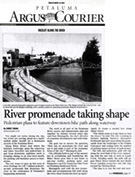
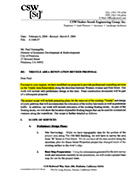
Quoted in the 8/4/2004 Argus Courier: “The old wooden railroad trestle that begins at the intersection of Western Avenue and Water Street will be torn out due to rotting pillars at the waterline. They're just too far gone," he said. "It cannot be salvaged." • CSW[St]2, the engineering firm hired to plan the Trestle rehabilitation, wrote a letter to Marangela acknowledging his prior instructions to only consider plans that require complete demolition. Apparently the decision to demolish was made in advance, without thorough structural analysis or community input.From the letter dated 03/09/2004
"Pursuant of your request, we have modified our proposal to provide professional consulting services on the Trestle Area Renovation"… "The project scope will include preparing plans for the removal of the existing Trestle"
|  
 |
| 2/6/12 | February 6, 2012 - Staff Report to City Council on Trestle Rehabilitation.
Larry Zimmer, Capital Improvements Division Manager, and GHD, the engineering firm hired to come up with three alternatives for Trestle rehabilitation, present the alternatives to the City Council. - Zimmer and GHD referred to Option 3 (requiring demolition) as “strongly supported”.
- Mark Hulbert, Historic Architect, hired by GHD, makes the case that the Trestle is not historic because it is not formally registered as a historic structure. He insisted on the difference between APPEARING to be eligible for registering and actually BEING eligible. (though technically true, why would you try to confirm eligibility if it didn't APPEAR to be eligible?) His testimony contradicted the spirit of his own earlier report which seemed very upbeat about its actual historical significance and the possibility of getting official recognition. It seems his change of heart reflected the wishes of his Public Works employers who were laying the groundwork for persuading CEQA to accept the demolition of the Trestle.
- Open icon at top right to compare some of Hulbert's statements of 2/6/2012 with paragraphs from his own earlier report dated November 2011. Note that in paragraphs 13-15 Theresa Barrett points out CEQA will still consider a structure's historical significance even if not formally registered anywhere.
- Middle icon is the full November 2011 report
- Bottom icon is the full transcript of his statements on 2/6/2012
- Option 1 of the three alternatives, specifying the repair of the existing Trestle and not requiring demolition, was preferred by historic preservationists and confirmed in a later resolution by the City Council (see 7/16/12 below). Option 1 is the method later referred to as the 2013 Option in the Foth report of 2025.
Staff and GHD ‘strongly supported’ Options 2 and 3 after making Option 1 look bad by presenting it as a hodgepodge of different pile repair methods which resulted in an ‘ugly’ solution. However, these problems could be remedied easily: - The ‘ugliness’ of Option 1 (some piles needed bulkier jacketing, others could just be wrapped with thin material, screw piles were steel) was easily remedied by making the several methods appear similar.
- The helical screw piles aren’t even necessary as the existing piles only need to be repaired above mudline, the parts below mudline are in the anaerobic zone and still intact (think Venice’s 1000-year-old wood piles that support the city in a lagoon). The tilt of piles in the ‘failure zone’ are no longer being pushed or threatened by the reinforced river embankment, and tilted piles are commonplace in marine docks and trestles and can be stabilized and repaired like the rest.
| Compare Hulbert in Nov. 2011 v. Hulbert on Feb. 6, 2012
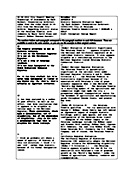
Full original Report by Hulbert Nov. 2011
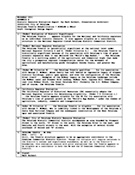
Full transcript of Hulbert to City Council
 |
| 7/16/12 | Agenda Item 5.B -- City Council meets and makes several resolutions re: the Trestle Rehabilitation Project. Pg 6: "BE IT FURTHER RESOLVED by the City Council that: 1. The Mitigated Negative Declaration is hereby adopted. 2. All mitigation measures identified in the Initial Study/Mitigated Negative Declaration are imposed upon the Project as conditions of approval."
"BE IT FURTHER RESOLVED by the City Council that: Staff is directed to proceed with design and specification documentation for the Project, Alternative 1, Rehabilitation."
Pg 7-8 Following the resolutions is a description of Alternative 1 - Rehabilitation Approach. This is basically the same as the earlier version of Alternative 1 from the presentation of 2-6-2012, with 3 scenarios for repairing or replacing rotten piles.
This is the 2013 Option referred to in the Foth report of 2025. | Text of the Resolution only
Full text of
Agenda Item 5.B |
2/27/14 | Frances Rivetti writes article for Argus Courier lamenting Trestle Rehabilitation Project is “stalled” In a brief statement (at short notice) by Diane Ramirez, project manager for The Petaluma Trestle Rehabilitation, agreed that the project is stalled. "The engineer's construction estimate provided as part of the design project was approximately five million. To my knowledge we do not have that amount of money available to allocate to the rehabilitation project," she said.
The engineer's preferences for expensive materials (like screw piles) and unnecessary labor ( like removing the mostly intact and adequate stringers to add steel reinforcing plates that would actually catch rainwater and contribute to future dryrot) that may have driven the estimate too high. But there never seems to be any money in the city budget to take care of the Trestle. | 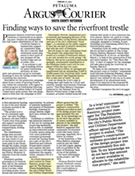 |
5/11/25 | History Repeats Itself
On May 9, 2025, Foth presented the document:
“Petaluma Trestle Renovation – Design Concept Options Analysis – Final” to Petaluma Department of Public Works. Foth came up with nine methods for renovating the Trestle. - The 2013 Option, the first on the list, is the only one to maintain the historic integrity of the Trestle and is the least expensive of the nine. This option retains as much of the wooden superstructure as possible, and repairs and reinforces the damaged portions of the piles.
- Options 1-8 all require the complete demolition of the Trestle before replacing it with a replica made from a variety of modern materials. Replicas would retain the footprint and rough shape of the original.
- Options 1-8 do not maintain historic integrity.
There is a major obstacle to pursuing any of those eight options:
CEQA requires that any project that would have an “adverse effect” on an historic resource under Section 106 cannot proceed until an Environmental Impact Report is submitted showing measures to minimize, avoid, or mitigate the adverse effects. - Quote from Foth report, page 41, last paragraph
“Design Options 1 through 8 would involve the demolition of the existing Petaluma Trestle and the construction of a new structure that is intended to mimic the historic structure to varying extents. Due to the demolition of the existing Petaluma Trestle, the Petaluma Trestle renovation project may result in a finding that the project would have a “significant and unavoidable” impact to the historic resource, the Petaluma Trestle, under CEQA and an “adverse effect” on the historic resource under Section 106 of the NHPA.”
- Complete demolition of the Trestle would be an extremely “adverse effect” on a historic resource.
Demolition would destroy eligibility for grants from any agencies promoting historic preservation (for example the State Coastal Conservancy) limiting the pool of potential funding sources. Demolition is too drastic for CEQA to approve.
| Click to see the FOTH Report
Links in text go to individual pages of this document |
5/11/25
Defense of the 2013 Option | The 2013 Option (Option One from the GHD plan, the option not requiring demolition) is the least expensive and the only method that maintains historic integrity. - Quote from Foth report, page 41, second to last paragraph
“The 2013 design option includes the preservation and reuse of portions of the existing Trestle. This option has the potential to be constructed in a manner that conforms with the U.S. Secretary of the Interior's Standards for the Treatment of Historic Properties under the Treatment of Rehabilitation, which is defined as “the act or process of making possible a compatible use for a property through repair, alterations, and additions while preserving those portions or features which convey its historical, cultural, or architectural values.”
Despite these important advantages, the Foth report (5/9/25) deprecates the 2013 Option and supports the other eight, all requiring demolition. The rather weak argument used for deprecating the 2013 Option is that its Service Life is (supposedly) only 25-30 years. We dispute the weak short service life assumptions (see next section below), and think it’s a bad faith argument, similar to the weak, bad faith argument Staff and GHD used in 2012 against Option 1.
Over the years Public Works repeatedly chooses expensive methods that won't pass CEQA requirements and that are hard to fund. We can only conclude that they do not want to deal with restoring and rebuilding the existing Trestle for their own undisclosed reasons.
| |
5/11/25
Questioning Service Life assumptions | The Service Life of the components used in the 2013 Option have been drastically underestimated.
Table 2-2, Pg 15 from the FOTH Report: 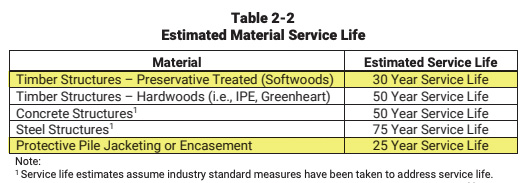
- Jacketing to repair eroded piles, either Fiberglas or PVC, plus epoxy or concrete grout, are warrantied for 25-30 years but are expected to last 50 years or more. Jacketed piles are guaranteed to be twice as strong as the original. All pilings below the mudline are in the anaerobic zone and not subject to decay, so all repairs have to extend down to the still solid portions.
Quote from the transcript of Craig Lewis’s presentation to City Council 2/6/12 re: Alternative 1 We looked at restoring the timber piles. ... The use of an FRP material, fiber reinforcement polymer material. That's a jacket that goes around the piles, the existing piles, it's slightly oversized and grout concrete is pumped in between the jacket and the existing timber. The remainder of the piles, again to restore or protect basically the remaining capacity of the pile, we would wrap them in a high density polyethylene wrap... ...that goes around the existing timber and prevents any future deterioration to those piles
- The Bent Caps, stringers, joists and ties are all ‘Softwood timber’, in this case Redwood and treated Douglas Fir that are never submerged in the river. Considering that they successfully carried 200-ton locomotives with minimal maintenance for about 70 years, it seems reasonable that the ‘softwood’ superstructure, when the damaged portions (estimated at 20%) are replaced, will last another 70 years for pedestrian use only.
Quote from Porter & Associates 7/14/23 “Wood Condition Assessment" Since many structures were built before building codes or design values for wood products were established (and, thus, before grade stamps were used), engineers are often in a quandary when determining what design values are appropriate. Frequently an assumed species and grade are assigned, only to show that the wood members are structurally deficient. The result is often an overly conservative estimate of design values and unnecessary replacement and repair decisions with the associated unnecessary project costs.
(from Pg 12)
|
| 5/11/25 | The 2013 Option is also the least expensive solution.
Table 7-4, pg.44 from the Foth Report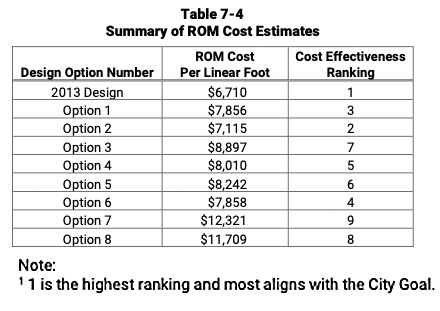
Table 7-4 from the Foth report shows that the 2013 Option has the lowest cost per linear foot and most aligns with the City Goal. |
| Conclusion | What will it take to convince the City Council to override the Public Works staff and their engineers and pursue the 2013 Option, as it is clearly the best option? - Will clear CEQA and Section 106 requirements
- Will retain the Trestle’s historic integrity
- Most cost-effective option
- The only option eligible for Historic structure related grants
|